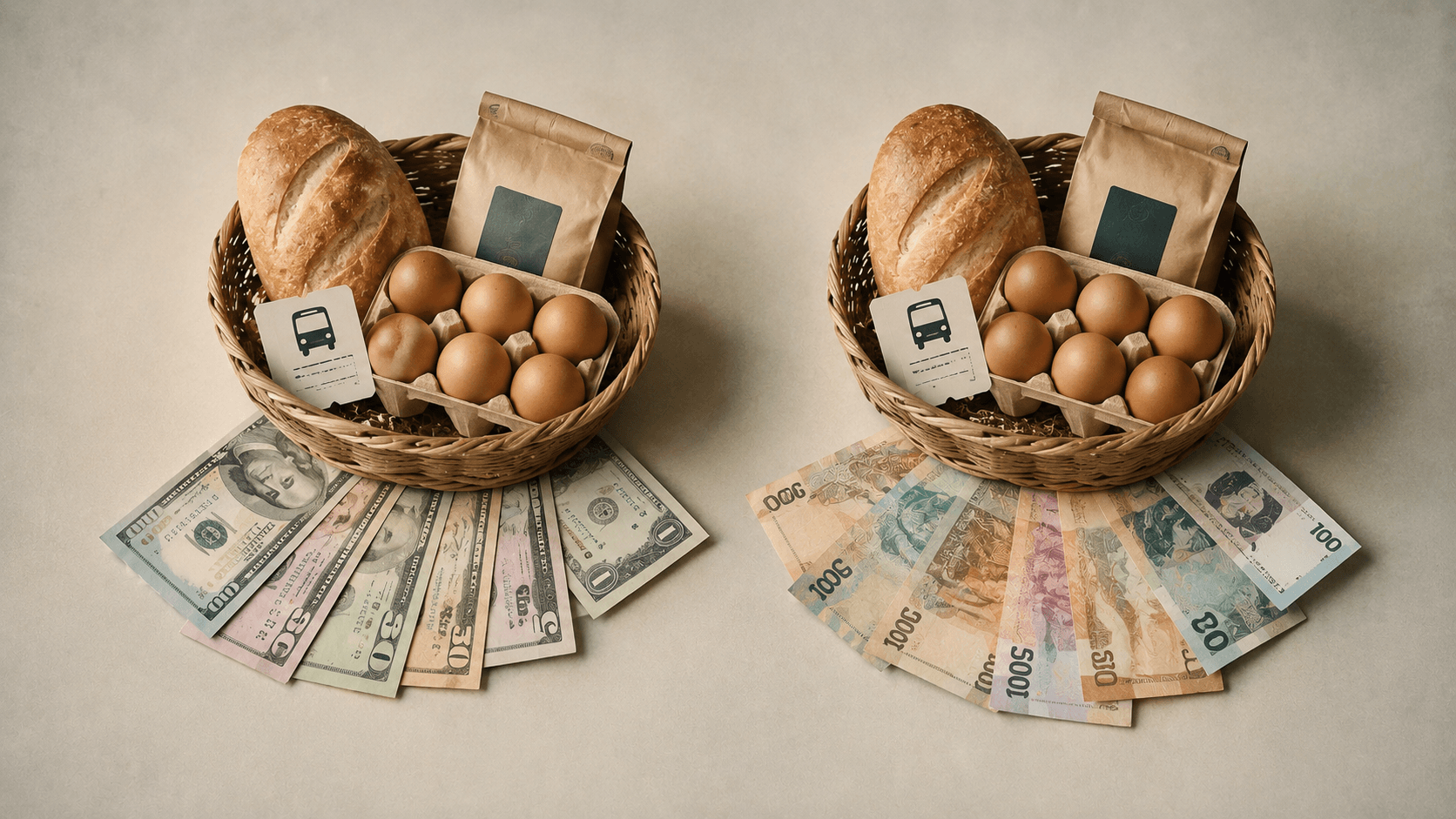
Type "cost of living by country" into a search engine and you'll get a tidy list of index numbers. Almost none of the people who cite those numbers can tell you what they measure — and a surprising share of the raw figures, including one on our own site, mean the opposite of what they look like.
This is the explainer I wish existed before I started building country data. There are really three different "cost" numbers, they are routinely confused, and the most authoritative-looking one is the easiest to misread.
Three numbers people treat as one
- Nominal price — what a thing literally costs in local money. A coffee is 8,000 rupiah in Jakarta and $4 in Chicago. Useful on the ground, useless for comparison until you convert it.
- The PPP conversion factor — how many units of local currency you need to buy the same basket of goods that one US dollar buys in the United States. This is what the World Bank publishes as PA.NUS.PRVT.PP, and it's the number on our methodology page. Its unit is local currency units per international dollar — and that unit is the trap.
- The price-level index — what you actually want: how expensive a country is relative to another, expressed as a clean percentage (the EU average = 100, say). This is what Eurostat publishes and what most "cost of living index" sites are gesturing at, whether they know it or not.
Confuse 2 and 3 and you will rank countries backwards. Here's how.
The number that means the opposite of what it looks like
Look at the raw "highest values" on our PPP conversion-factor page and you'll see Iran at 157,796, Lebanon at 58,470, Somalia at 10,392. If you read "highest PPP factor = most expensive," you'd conclude Iran is the priciest country on Earth. It isn't. It's one of the cheapest in dollar terms.
The reason is the unit. The PPP factor is denominated in local currency, and Iran's rial and Lebanon's pound have lost enormous value. It takes 157,796 rial to buy what a dollar buys partly because a rial is worth almost nothing — not because Iranian groceries are expensive. The factor is doing its job; the reader is misreading it.
I'll be honest: this is a place our own product can mislead you. Our page sorts by the raw value and notes "higher value = your dollars stretch further" — which is the right intuition only after you account for the exchange rate, and is exactly the kind of single-number shortcut this whole site is supposed to warn you against. Treat the raw factor as an input, not an answer.
The one operation that fixes it
To turn a PPP conversion factor into something you can actually compare, you divide it by the market exchange rate:
price level ≈ PPP conversion factor ÷ market exchange rate
If a dollar buys what 15,000 rupiah of goods buys (the PPP factor) but the market rate is 16,000 rupiah to the dollar, then Indonesia's price level is roughly 15,000 ÷ 16,000 ≈ 0.94 — about 6% cheaper than the US for that basket. Do the same arithmetic for Iran and the apparently "expensive" 157,796 collapses into one of the lowest price levels in the world, because the market exchange rate is also enormous. The exchange rate is the missing half of the calculation, and a raw factor table silently leaves it out.
This is why the cleaned-up price-level indices from Eurostat and the PPP series from the OECD exist: they've already done the division and rebased everything to a common 100, so the number is directly readable. The trade-off is coverage — those clean indices are richest for Europe and OECD members and thinner elsewhere, which is exactly where the raw World Bank factor (207 countries) still earns its place.
Where the numbers come from — and how old they are
Even the right number has a vintage you should check. The World Bank's PPP data comes from the International Comparison Program, a genuinely enormous statistical exercise that prices a common basket across the world. But the full benchmark only runs every few years — the 2021 cycle is the latest complete round — and the figures you see for 2024 or 2025 are interpolations between benchmarks, not fresh price surveys. The world median factor sits around 6.2 local-currency units per international dollar, for reference.
That matters for the same reason dates always matter here: a country whose currency moved sharply after the last benchmark can carry a PPP figure that hasn't caught up. In a stable economy that's a rounding concern. In a country mid-crisis — the kind of place where the exchange rate moves monthly — an interpolated PPP number can be meaningfully stale, and no index will flag that for you. You have to know to ask.
How to read a cost-of-living number without being fooled
A short checklist, which is really the whole article:
- Check the unit first. "Local currency per international dollar" is a conversion factor, not a price level. A clean index rebased to 100 is the comparable one.
- Never rank by a raw PPP factor. Weak-currency countries float to the top and look expensive when they're cheap.
- Divide by the exchange rate (or use a pre-built price-level index) before you compare anything.
- Read the year. ICP benchmarks are periodic; between them you're looking at interpolations.
- One number is never the cost of living. It's an average over a basket that isn't your basket — more on that in the companion piece on how to compare two countries honestly.
None of this is a reason to distrust the data — it's a reason to read it properly. The figures from the World Bank, Eurostat, and the OECD are some of the most carefully constructed statistics that exist. They just don't survive being flattened into a single listicle number, which is what most "cheapest countries" pages do to them.
Don't trust a cost-of-living index that won't tell you its unit and its year. Open the World Bank's PPP indicator, read what it actually measures, and if you want the answer the index is reaching for, build it yourself on our comparison tool — or at least know which of the three numbers you're looking at. The unit is the whole story.