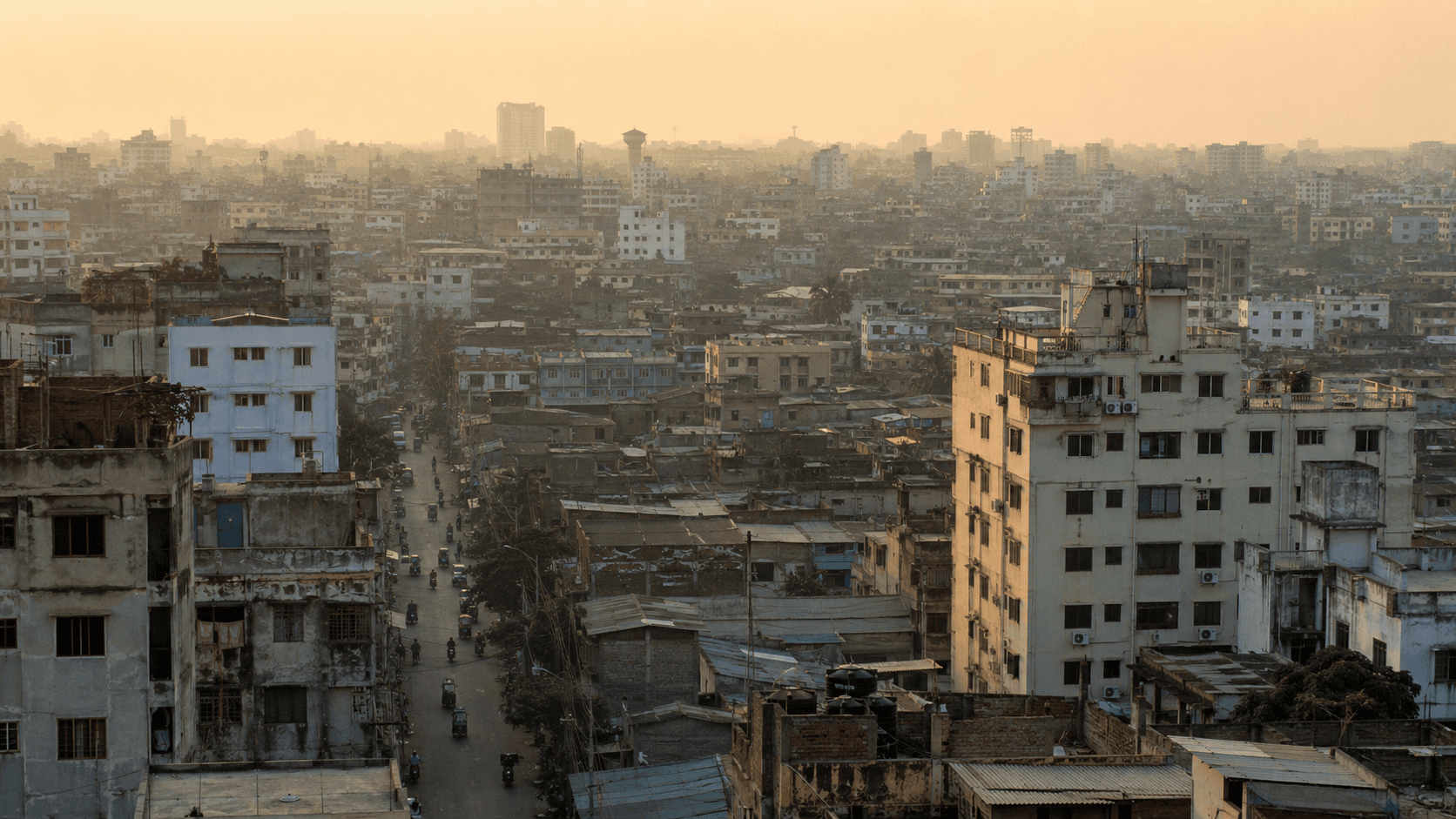
If you searched "how many people in Bangladesh," you came here for one number. We will start there. But if you stayed on this page, the population is the entry point — the actual story is how 173 million people fit into a country smaller than the US state of Iowa, and what our other data says about life in that arrangement.
The population answer
173,562,364. That is Bangladesh's population in 2024, per the World Bank's most recent estimate. The figure grows roughly 1.2% a year.
That makes Bangladesh the 8th most populous country in the world (UN World Population Prospects 2024 revision) — sitting between Brazil (7th, ~213M) and Russia (9th, ~144M). Ethiopia recently overtook Mexico for the 10th spot, with Mexico now 11th. Older sources still list Mexico in the top 10; the 2024 UN revision is the cleanest current ranking.
Bangladesh's land area is 147,570 km². For US readers, that is between Iowa (145,746 km²) and Wisconsin (169,635 km²). For UK readers, it is comparable to England plus Wales combined. For most people anywhere, the relevant fact is that it is small for a country containing 173 million people.
Density is the real story
Population by itself is easy to file away as a number. What makes Bangladesh distinctive in the data is what happens when you put that population on that land area:
1,319 people per square kilometer (2023 World Bank; see the underlying World Bank population-density dataset). That is among the highest national densities in the world for any country larger than a city-state.
When we first built our country dataset, Bangladesh's density was the number that consistently surprised every reviewer. Geographic-trivia familiar to South Asians is genuinely unknown to many North American and European readers — the country comes up so rarely in Western media that its scale is invisible by default.
To anchor the scale, here is how that compares to other populous countries:
| Country | Density (people/km²) |
|---|---|
| Bangladesh | ~1,319 |
| India | ~485 |
| Japan | ~330 |
| China | ~150 |
| Mexico | ~67 |
| United States | ~38 |
Bangladesh is roughly 2.7× denser than India and 35× denser than the US. Density also concentrates: Dhaka, the capital, is one of the densest megacities on the planet, with greater-Dhaka neighborhoods regularly cited above 40,000 per km² — denser than Manhattan's ~29,000 per km².
Density shapes much of what follows in the data — how housing works, how infrastructure scales, how air quality behaves, how political stress propagates. Keep it in mind as the rest of the indicators land.
The economy in two numbers
GDP per capita in 2024 was $2,593 USD in current dollars (World Bank — Bangladesh, NY.GDP.PCAP.CD). Our country page shows a different figure of $1,941 because we display GDP/cap in constant 2015 USD for cross-year comparability — both are valid, they just answer different questions ("how much does Bangladesh produce per person, in today's dollars" vs "how is per-person output trending over time, holding 2015 prices constant"). Either way, Bangladesh sits among lower-income economies — well below the US ($86K), the UK ($52K), or even regional comparators like Vietnam ($4,700) and Sri Lanka ($4,500, after the post-2022-crisis IMF-program rebound).
The Human Development Index sits at 0.685 in UNDP's HDR 2025 (released May 2025, covering 2023 data; rank 130 of 193) — squarely in the "medium human development" band. The HDI combines income, education, and life expectancy. Bangladesh has been rising in the index since 1990, when its score was around 0.39. The 2023 figure represents a roughly 75% improvement across a generation. Our country-page indicator card still shows the prior cycle's 0.670 (2022); we'll refresh on the next ingestion run.
What does that look like in lived terms? Life expectancy in Bangladesh is 74.7 years (UNDP HDR 2025, 76.4 women / 73.0 men) — higher than its income bracket would predict. Bangladesh outperforms its GDP-per-capita peers on health outcomes. That has a paradoxical edge, which §4 picks up.
Three numbers that surprised us
Three indicators from our data on Bangladesh stand out — not because they are obscure, but because they push back against the GDP-per-capita-tells-you-everything assumption.
1. Healthcare cost is paid almost entirely out of pocket — 79.3%. Out-of-pocket spending makes up 79.3% of current healthcare expenditure in Bangladesh (2023; World Bank OOP-share dataset). That is the top 0% globally — among the highest household healthcare-burden countries measured. For comparison: the OECD average is roughly 20%; even India sits closer to 50%. Combined with 2.2% of GDP spent on healthcare (one of the lowest ratios in the world), the result is a healthcare system where the state covers a small share and households fill the gap directly. The life-expectancy bonus from §3 happens despite this, not because of it — driven heavily by public-health and vaccination programs run on tight budgets.
2. 100% of the population breathes air above WHO health guidelines. Bangladesh's annual mean PM2.5 is 42.4 µg/m³ (2020 World Bank PM2.5 dataset, modeled per State of Global Air — Brauer / HEI / IHME). The WHO 2021 air-quality guideline is 5 µg/m³ — Bangladesh sits at roughly 8× that level. According to the World Bank's modeled coverage, 100% of Bangladesh's population lives in areas above WHO's PM2.5 threshold. Density, industrial growth, monsoon-season brick-kiln burning, and Dhaka traffic combine to make air quality a national-scale exposure with no real escape valves within the country.
We double-checked the "100%" figure because it sounded too extreme. The number is right. Part of why it lands at exactly 100% is that the WHO 2021 guideline tightened the threshold from 10 µg/m³ to 5 µg/m³ — under the older threshold, fewer Bangladeshis crossed it; under the current threshold, nobody escapes it.
3. Happiness score in the bottom-most band. On the World Happiness Report's Cantril Ladder, Bangladesh scored 3.851 out of 10 in WHR 2025 (released March 2025; rank 134 of 147), published by worldhappiness.report. That places it in the bottom 10% of countries measured (our country-page card still rounds to 3.9 from the WHR 2024 cycle; refresh pending). For context, Finland leads the index at ~7.7; Afghanistan trails at ~1.4 (also a downward shift from WHR 2024's 1.7). Bangladesh sits well below the global median. Happiness scores are self-reported life-evaluation surveys — they capture how people in a country rate their own lives, not an external judgment. A score below 4 reflects a population reporting significant strain across the dimensions WHR measures: income, social support, healthy life expectancy, freedom, generosity, and corruption perception.
Why people live there — and why the population still grows
A real GSC query that landed on this page reads simply: "why do people live in bangladesh." It is a curious question — almost philosophical when phrased that bluntly. The data offers a partial answer.
Bangladesh's population is still expanding by roughly 1.2% per year despite low GDP, high density, and high air-pollution exposure. The country is not in demographic decline. People live there because:
- It is the country they are from. Migration out of Bangladesh exists, but the great majority of births are to citizens whose families have lived in the region for generations or centuries.
- Family + cultural anchors. Bangladesh is overwhelmingly Bengali (~98%) and predominantly Muslim (~91%) — strong shared cultural and linguistic identity.
- Economic growth despite low base. GDP per capita is growing 3% annually; the country is improving rapidly even if the absolute level remains low.
- Working-age demographic dividend. Bangladesh has a young, expanding labor force at a time when many developed countries are aging.
- Geographic concentration of opportunity. The Bay of Bengal coastline and river-delta agriculture are productive enough — and Dhaka concentrates job opportunity enough — that internal economic gravity is strong.
The harder edges of the picture are also real. Political stability scores fell 15.1% year-over-year on the World Bank 2024 Worldwide Governance Indicators — reflecting the July-August 2024 student-led uprising over quota policy, Sheikh Hasina's resignation on 5 August 2024, and the subsequent Muhammad Yunus interim government. (The 2024 WGI release likely under-captures this — it covers 2024 calendar year data; political-stability estimate fell sharply from -1.04 in 2023 to -1.46 in 2024, and the next WGI release may show an even larger percentile drop than -15.1%.) Rule of Law sits at 40.4 and Control of Corruption at 25.5, both in the bottom global bands. The data does not say living in Bangladesh is good or bad — it says it is concentrated, growing, lower-income, polluted, and going through political stress. Different readers will weight those differently.
What our data leaves out
The article has not answered everything you might want to know about Bangladesh.
One specific GSC search that landed here was "bangladesh median income." We did not cite a figure for that because we do not currently carry a household-median-income indicator for Bangladesh — what we have is GDP per capita (a country-level average, easily distorted by inequality at the top). Median is a more honest household-life signal; we plan to add it when reliable comparable data is available across enough countries to support cross-comparison.
More broadly: indicators describe a country at the scale of millions. Bangladesh's 173 million people include rice-paddy farmers in Sylhet, garment workers in Dhaka's Mirpur district, fishing communities along the Sundarbans, university students in Chittagong, and migrants returning from the Gulf. The numbers in this article point you in a direction. They do not substitute for the people.
If you want to verify any figure here against its primary source, the full Bangladesh country profile has every indicator linked to the World Bank, UNDP, World Happiness Report, or other origin source it came from. Click through, check the year, find a fresher figure if you can. That is what this data set is for.