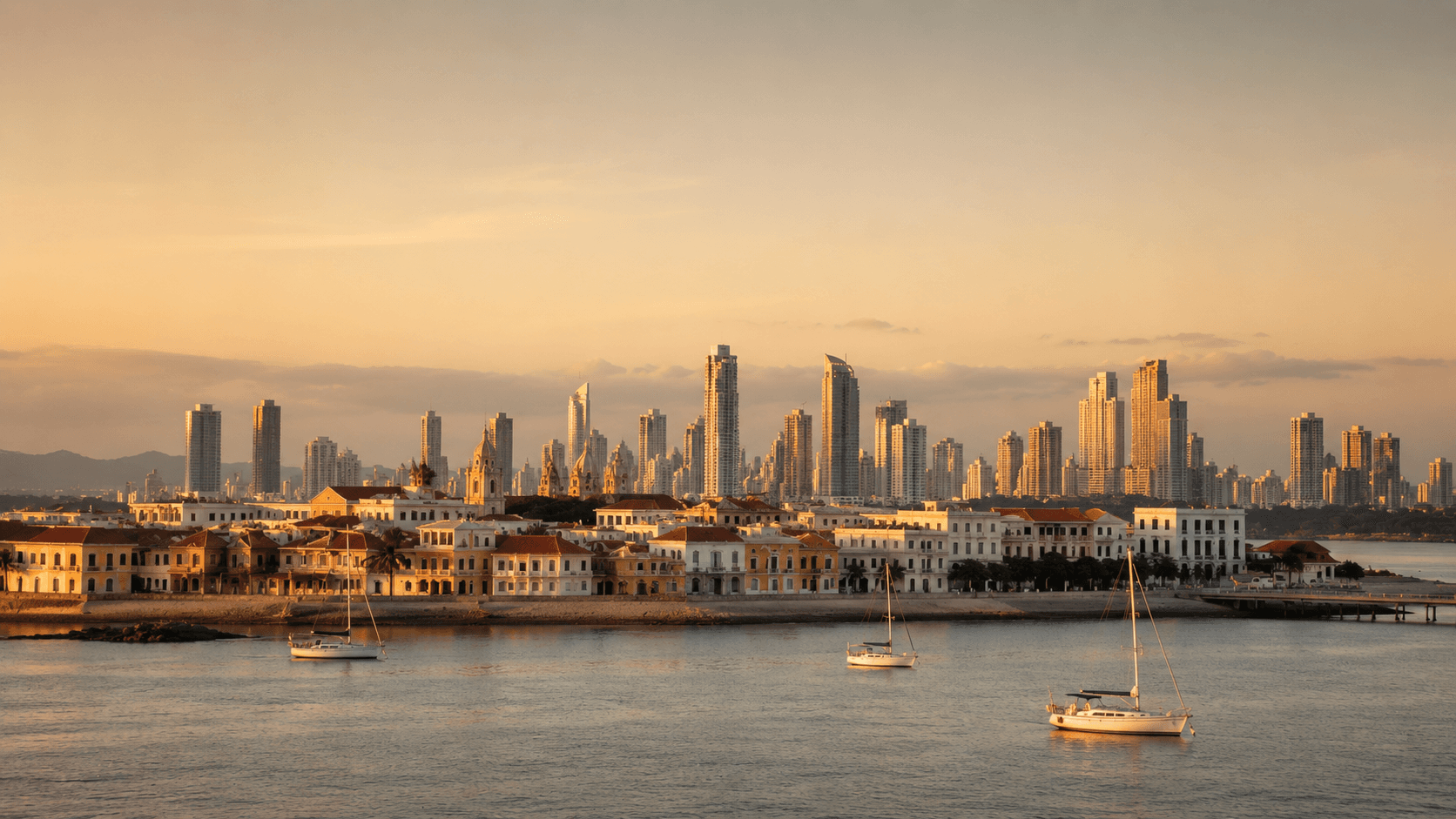
The retirement visa everyone recommends — and why
Ask anyone who's researched retiring abroad which Latin-American retirement visa keeps coming up, and the answer is almost always Panama's Pensionado. It's the most-searched LatAm retirement program we track, and the reasons hold up to scrutiny: a low, fixed income bar; an economy that runs on the US dollar, so there's no currency-conversion risk on your pension; a famous package of resident discounts; and one structural feature that genuinely sets it apart from nearly every peer — it grants permanent residency on approval, with no temporary-residency waiting period to serve first.
There are also two things about it that most listicles get wrong, and they matter: the Pensionado has no age requirement despite its name, and the income test is a lifetime pension, not just any monthly income. Get those two facts right and you'll know in about thirty seconds whether this visa is even available to you. This guide walks through the requirements, the cost, the famous discounts, and how Panama stacks up against its closest rivals — Costa Rica's Pensionado and Mexico's Temporary Resident visa.
Who it's actually for (it's not just retirees)
Here's the first surprise. "Pensionado" translates to "pensioner," and every instinct says this is a visa for people of traditional retirement age. It isn't — there is no minimum age. What Panama tests is the source of your money: you need a qualifying lifetime pension or annuity, not a 65th birthday.
That reframes who this is for. A 45-year-old with a government pension, a military pension, a corporate defined-benefit pension, or a lifetime annuity from an insurance company can qualify just as cleanly as a 70-year-old. I find this genuinely under-appreciated — the FIRE crowd and early-retirees spend enormous effort hunting for visas that don't gate on age, and one of the best-regarded options in the hemisphere has quietly never had an age gate at all. The catch is in the word lifetime: ordinary investment income, rental income, or a salary won't satisfy the Pensionado test the way a guaranteed lifetime pension does. (If your income is passive-but-not-a-pension, Panama's other routes — or a different country's rentista visa — may fit better; more on that below.)
The standout: permanent residency on day one
This is the feature that earns Panama its reputation. Most Latin-American retirement visas hand you a temporary residency first — one, two, or three years — and only later let you convert to permanent residency. Costa Rica's Pensionado, for instance, runs as temporary residency with permanent residency available after three years; Mexico's Temporary Resident card runs up to four years before you can apply for permanent status.
Panama's Pensionado is different: approval grants permanent residency directly. There's no temporary-residency probation period to maintain, no annual re-proving of income for years before you're "in." Per Panama's immigration authority (Servicio Nacional de Migración), the Pensionado is a permanent-residence category from the start.
Why does that matter beyond bragging rights? Because it changes the relocation math. A temporary-first program means your early years carry renewal paperwork, re-verification of income, and the risk that a missed requirement resets your clock toward permanent status. Direct permanent residency removes that overhang — you arrive, you're approved, you're permanent. For someone consolidating their life into one move, that certainty is worth a great deal. (Note: permanent residency is not citizenship — naturalization in Panama is a separate, longer process. We cover where each retirement visa actually leads in our citizenship-path piece, where Panama's direct-PR feature is a standout.)
The requirements: the US$1,000 lifetime-pension test
The core financial requirement is a lifetime pension of at least US$1,000 per month, payable from a government or a private/corporate source, and documented as guaranteed for life. Because Panama's currency (the balboa) is pegged 1:1 to the US dollar and US dollars circulate as legal tender, there's no exchange-rate game to play — US$1,000 is US$1,000.
A few specifics worth confirming against the primary source before you build a plan around them (these are the figures aggregators most often report inconsistently):
- A confirmed variant lets you qualify at a reduced US$750/month pension if you also own Panamanian real estate worth more than US$100,000 in your own name — both figures appear in the immigration authority's own pensionado requirements. (It's still wise to re-check the current threshold on migracion.gob.pa before you buy property around it.)
- Dependents (spouse, children) can typically be added with an income top-up per dependent.
- You'll need the usual documentary set — a clean criminal-record certificate, a health certificate, a valid passport, and notarized/apostilled proof of the lifetime pension.
The income bar is genuinely low by developed-world standards — US$1,000/month is below the threshold of most European retirement visas — which is the other half of why Panama ranks so highly for affordability-minded retirees. Pair it with our look at where US$1,500/month actually stretches to see how far a modest pension goes in practice.
The discounts: Panama's pensionado benefit regime
Panama is famous for legislating a wide schedule of discounts for pensionado/jubilado residents under Law 6 of 1987 (amended many times since, and now applied as a consolidated Texto Único) — and these apply to qualifying foreign Pensionado-visa holders, not just Panamanian retirees. The headline reductions are substantial and come straight from the statute: roughly 50% off entertainment (cinema, theater, sporting and public events), 25% off restaurant meals (about 15% at fast-food outlets), 25% off airline tickets, 50% off hotels Monday–Thursday (30% on weekends), 25% off electricity up to 600 kWh/month, 20% off prescription medicines, and 15% off private hospital and clinic bills.
Those percentages trace to the law itself, but because Law 6 of 1987 has been amended repeatedly it's still worth confirming the current schedule on a Panamanian government source rather than a relocation blog — stale versions get copied across aggregators, exactly the pattern we caution against. The healthcare angle matters most: given that out-of-pocket costs are a major line item for retirees everywhere (see our out-of-pocket health methodology), legislated discounts on hospital and pharmacy bills are not a trivial perk.
Cost and how you apply
Two practical points shape the real cost and timeline:
You apply in-country, through a Panamanian attorney. Panama's immigration law requires residence applications to be filed by a licensed Panamanian immigration attorney, with the applicant appearing in person at the Servicio Nacional de Migración in Panama City (and again to collect the residency card). That means the Pensionado is an apply-after-you-arrive program — you enter Panama, then file — which is the opposite of Europe's consulate-from-origin retirement visas. We mapped this split in where you can apply for a retirement visa from; Panama sits firmly in the in-country camp, and the mandatory attorney is the main cost line beyond government fees.
Budget for the attorney plus government fees, not just the fees. Because the attorney is effectively required, the legal cost is part of the program's real price — typically the largest single setup expense. Confirm current government fee amounts on the primary source; they're modest relative to the legal fees.
Panama Pensionado vs its rivals
The fastest way to know whether Panama is your pick is to set it against the two programs it's most often compared to:
| Program | Income test | Residency granted | Notable |
|---|---|---|---|
| 🇵🇦 Panama Pensionado | US$1,000/mo lifetime pension | Permanent on approval | No age gate; USD-pegged; discount regime |
| 🇨🇷 Costa Rica Pensionado | US$1,000/mo lifetime pension | Temporary → PR after 3y | Caja public-healthcare access |
| 🇲🇽 Mexico Temporary Resident | ~US$4,300/mo income or ~US$7,200/mo pension (UMA-indexed) | Temporary (4y) → PR after 4y | Higher bar; apply from consulate abroad |
Two takeaways. First, Panama and Costa Rica share the same low US$1,000/month pension bar, but Panama gives permanent residency immediately while Costa Rica makes you wait three years — if direct PR matters to you, that's the tiebreaker. Second, Mexico's bar is several times higher and it's an apply-from-abroad program, so despite Mexico's popularity it's a different (and pricier) proposition than the two Central American pensionados. If you want the worker/non-pension route into Panama instead, that's the Friendly Nations Visa (a US$200K-investment-tier program since the 2021 reform) or the short-stay remote-worker visa — different visas for people without a lifetime pension. Line any of these up in the visa comparison tool.
Verify before you commit, and where to go next
The durable facts here — US$1,000/month lifetime pension, direct permanent residency, no age requirement, the US$750-with-US$100,000-property variant, and the USD-pegged economy — trace to Panama's immigration authority and our visa data, and were re-verified against primary sources in mid-2026. The things still worth re-confirming on migracion.gob.pa before wiring money or retaining a lawyer: current government fees, and — since Law 6 of 1987 has been amended many times — the discount schedule as currently applied. These are the details aggregators copy without checking.
If Panama fits — you have a qualifying lifetime pension and you value direct permanent residency — your next steps are to read up on Panama itself, compare it head-to-head with Costa Rica's Pensionado (the closest rival, covered next in this series), and rank it against the field in the retirement explorer. If you don't have a lifetime pension, the Pensionado isn't your door — look at Panama's Friendly Nations route or a rentista-style visa elsewhere.
Don't trust a list. Read the immigration authority's own page, confirm the pension counts as a lifetime pension, and remember the rule the name hides: this is a visa about your pension's source, not your age.