Most country profiles for Sudan read like they were written in 2015 and never touched again. That is a problem, because the single most important fact about Sudan today is that its numbers are moving — and moving the wrong way, fast. Since April 2023 the country has been at war, and the data has started to register it.
This is Sudan by the numbers, as of mid-2026. Every figure links to its primary source. None of it is our opinion; the interpretation is, and you should check it.
The headline four
- Population: 50,448,963 (World Bank, 2024) — the 28th most populous country of the 250 we track. Bigger than Spain, bigger than Argentina.
- Land area: 1,886,068 km² — among the largest in Africa, roughly three times the size of France.
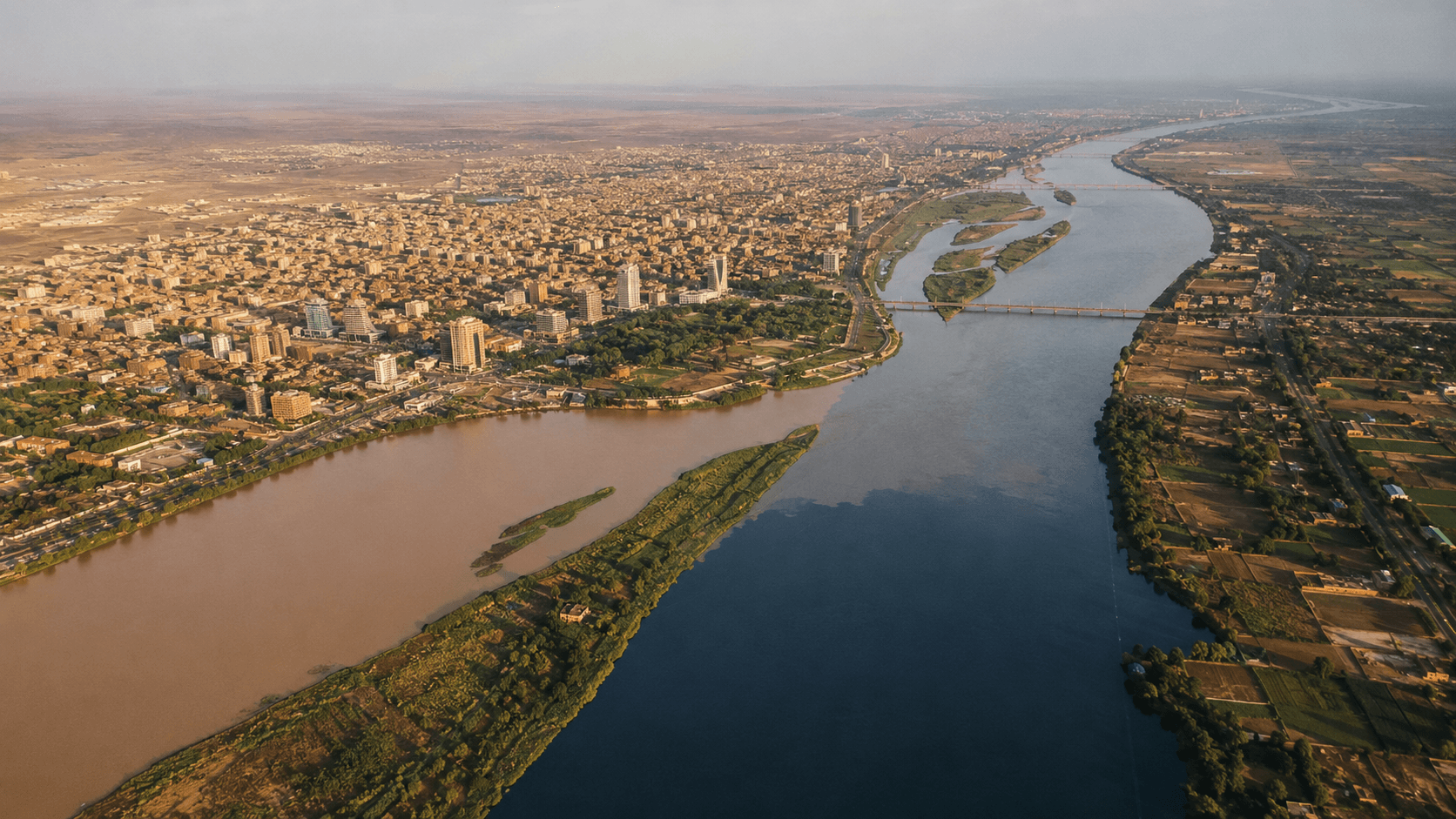
- Population density: 27 people/km² — sparse, denser than only about a quarter of countries. A big country, thinly settled, with people concentrated along the Nile.
- Human Development Index: 0.511 (UNDP, 2023) — in the bottom 12% globally, the "low human development" band, and edging down year on year.
Those are the figures people search for, and they are the ones most listicles stop at. The story is in what happens when you look at how they're changing.
The war is in the data
Here the headline figure lies by omission, and learning to catch that is the whole point. Sudan's GDP per capita in current dollars is US$985 (World Bank, 2024) — and it rose about 23% in a year. Read that number alone and you'd think the economy was recovering. It isn't. A current-dollar figure is inflated by a collapsing currency and surging prices; strip those out and look at real output per person (constant 2015 dollars) and it fell about 14.7% in 2024 — on top of a roughly 40% real collapse in 2023 (African Development Bank). A "bad recession" in a developed country is a 2–4% dip; Sudan has lost something close to half of its real output per person across two years of war. The nominal rebound is a price-and-exchange-rate mirage, and knowing to look past it to the real series is exactly the skill this site is built to teach.
The governance indicators tell the same story from another angle. On the World Bank's Worldwide Governance Indicators (2024, percentile ranks), Sudan sits at roughly the 26th percentile on Rule of Law, 24th on Voice & Accountability, and near the 16th percentile on both Government Effectiveness and Control of Corruption — the bottom sixth of the world on the basic question of whether a state can function at all. When real output and institutional capacity are both this low in a country at war, you are not reading a development gap. You are reading a collapse with a date on it.
I want to be careful here, because this is exactly where a data site can overreach: the indicators don't prove the war caused the decline. But the timing, the magnitude, and the breadth — economic, institutional, and humanitarian all at once — line up with the conflict that began in 2023, and no competing explanation fits a real-output collapse of roughly 40% in 2023 and another 14.7% in 2024. That is as far as the numbers let me go, and it's further than most country pages dare to.
A health system under siege
If the GDP figure is the headline, the health data is the part that should stop you.
Sudan's out-of-pocket health spending is 57.4% of total health expenditure (World Bank, 2023) — in the top 10% worst in the world. More than half of every dollar spent on health in Sudan comes straight out of a patient's pocket at the point of care, the arrangement that pushes families into poverty precisely when someone falls ill. Meanwhile total health spending is 2.9% of GDP and falling — down nearly 25% year on year.
The capacity figures match: roughly 0.3 physicians per 1,000 people, and a maternal mortality ratio of 256 per 100,000 live births. Put plainly: few doctors, little public money, and most of the cost landing on households — in the middle of a war that is displacing millions. The data describes a system being asked to do the most at the moment it has the least.
What's stale — and why we flag it
Here is the kind of thing we'd rather tell you than hide. Sudan's internet-penetration figure is 18.6% — but that data point is from 2017. It is the most recent the World Bank publishes for Sudan, and it is almost a decade old. We show it because it's the best primary source that exists, and we label the year so you can weigh it accordingly. After years of conflict and infrastructure damage, treat a nine-year-old connectivity number as a historical artifact, not a current reading.
This is the difference between a data source and an aggregator: an aggregator quietly prints "18.6%" as if it were today's fact. We'd rather show the number, show the date, and let you decide it's too old to trust. That habit — distrust the freshness, not just the figure — is the whole point of reading a country by its numbers instead of by someone's summary of them.
How to read this country honestly
Sudan is a large, historically significant nation whose published statistics are, right now, a moving record of a catastrophe. The most useful thing you can do with the figures above is date them and track them, not memorise them. A population number holds up for years; a GDP-per-capita number in a war economy can be wrong within months.
If you want to see how Sudan sits against its neighbours or against a country you know, put it side by side on our comparison tool, and read the methodology behind the Human Development Index so you know what that 0.511 is actually built from. For a country whose data tells a very different — and more stable — story, our companion piece Bangladesh by the numbers is a useful contrast in how to read a dense, developing nation that is not in crisis.
Don't trust a country profile that doesn't show its dates. Open the World Bank's Sudan page and the UNDP's country data, check when each figure was last updated, and find a fresher one if you can. With Sudan, the freshness is the story.