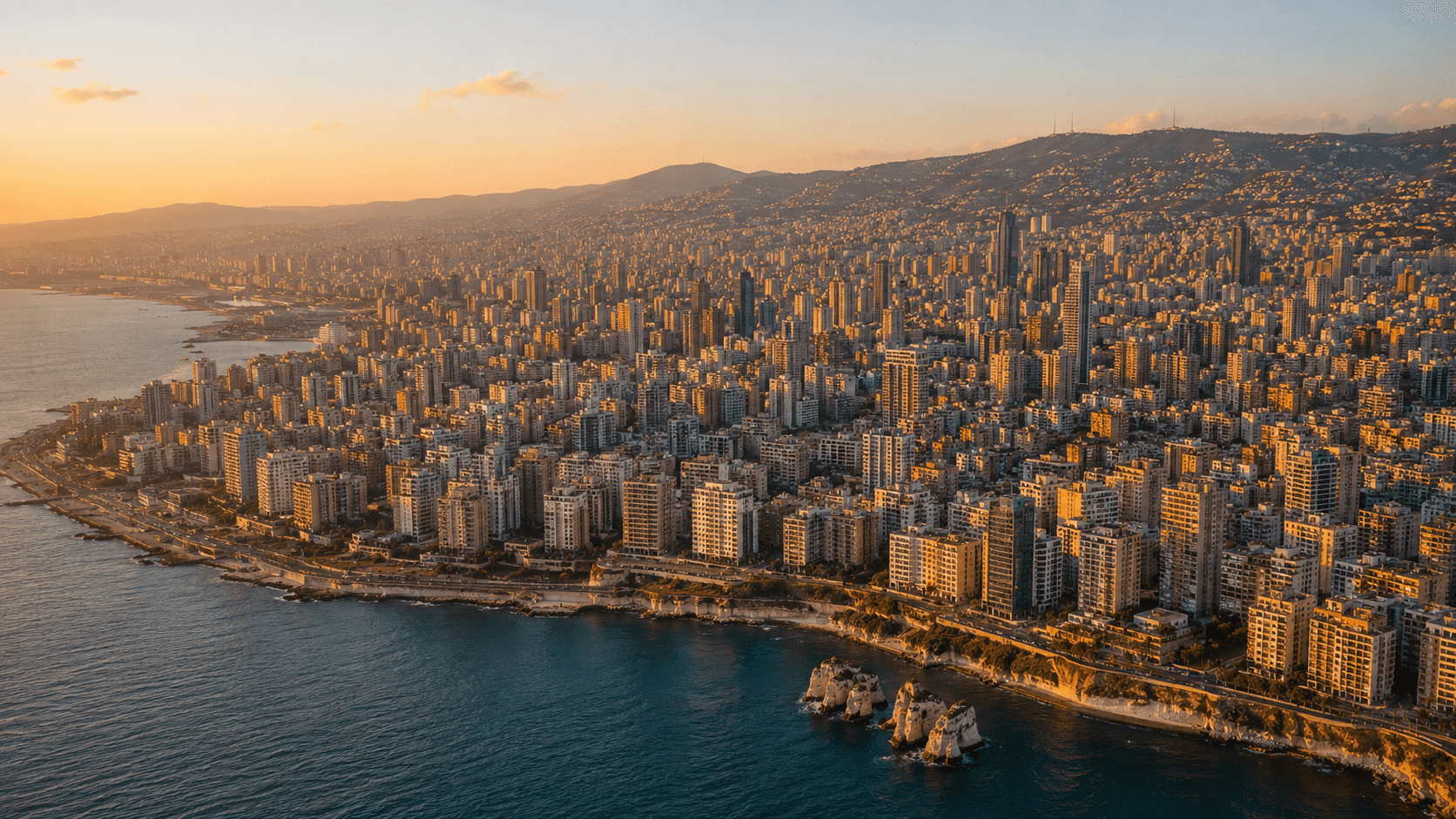
Run Lebanon through the standard development indicators and it looks like a middle-income success story: a Human Development Index of 0.752, more than 80% of the population online, a literate, urban, connected society. Then you reach one more number and the picture breaks in half.
Lebanese people rate their own lives at just 3.7 out of 10 — far below the global average of around 5.5, and one of the lower scores anywhere. That number has actually climbed sharply in the past year (it sat at 2.7 a year earlier), and it is still this low. That gap — between what the development data says and what Lebanese people report about their lives — is the most honest summary of the country in 2026. Here it is by the numbers.
The headline four
- Population: 5,805,962 (World Bank, 2024) — the 119th most populous of the 250 countries we track. A small country by headcount.
- Land area: 10,452 km² — tiny; you could fit Lebanon inside many single provinces elsewhere.
- Population density: 564 people/km² — in the top 10% most densely populated on the planet, denser than about 90% of countries. Small land, a lot of people, heavily concentrated on the coast.
- Human Development Index: 0.752 (UNDP, 2023) — squarely in the "high human development" band, the middle of the global pack.
On these four alone, Lebanon reads like a perfectly ordinary upper-middle country. That is exactly why the next section matters.
The paradox
The Cantril ladder — the survey behind the World Happiness Report, which asks people to rate their own lives from 0 to 10 — puts Lebanon at 3.7, deep in the bottom ranks globally. To sit that low while holding an HDI of 0.75 is genuinely unusual. Human development and self-reported happiness usually track each other loosely; Lebanon has torn them apart. The score has rebounded sharply from a year earlier — it stood at 2.7 — but a one-year lift doesn't close a gap that wide; it just makes Lebanon a little less of an outlier than it was at the depth of the crisis.
What separates the two is the thing development indices are slow to capture: a financial system that collapsed. The HDI is built from life expectancy, schooling, and income measured over years, so it carries a lot of pre-crisis momentum — a society that was developed doesn't lose its schools and clinics overnight on paper. The happiness number has no such lag. It asks people how their life is going now, and the answer, after the currency and the banking sector imploded, is: badly.
I'll admit this is the country profile that changed my mind about which numbers to trust. If you only looked at HDI, you'd file Lebanon next to comfortable middle-income nations and move on. The happiness figure is the one screaming that the lived reality has decoupled from the development scorecard — and it's the one most country pages leave out entirely, because it's uncomfortable and it doesn't fit the tidy "developing vs developed" frame.
The governance numbers fill in the why
If happiness is the symptom, the World Bank's Worldwide Governance Indicators (2024, percentile ranks) are a fair sketch of the cause. Lebanon sits at the 21.5th percentile on Control of Corruption and the 29.4th on Government Effectiveness, with Rule of Law at the 38.3rd — the bottom quarter to third of the world on each. For a country with Lebanon's human capital, those are strikingly low: this is not a society short on education or talent; it is one whose institutions are failing the people inside them.
That combination — high human capital, low institutional quality — is its own kind of tragedy, and it shows up in the economy too. GDP per capita has sunk to US$3,478 (World Bank, 2023), down sharply from its pre-crisis level — the residue of one of the sharpest peacetime financial collapses in modern history. The number is a floor reached by falling, not a level reached by climbing.
What the data doesn't capture
Two honest caveats, because this is a country where the averages mislead more than usual.
First, dollarisation and the parallel exchange rate make any single income or price figure in Lebanon slippery. A GDP-per-capita number assumes a stable unit of account; Lebanon hasn't had one. Read US$3,478 as a rough order of magnitude, not a precise wage.
Second, the internet figure of 80.6% (2024) is real but tells you about access, not reliability — it can't show the daily power and connectivity interruptions that residents live with. A high penetration number and a functioning grid are not the same thing, and only one of them is in the data.
The point of flagging these isn't to dismiss the figures. It's the opposite: know exactly what each number can and can't tell you, and you can read Lebanon far more clearly than any summary that just lists its HDI and calls it "developing."
How to read this country honestly
Lebanon is the clearest case I've found for why a country can't be reduced to one index. The development data and the wellbeing data point in opposite directions, and both are true — they're just measuring different things over different timescales. Hold them together.
Put Lebanon next to a peer on our comparison tool and the decoupling jumps out; read what goes into the Human Development Index and you'll see why it lags a live crisis. For two other countries where the numbers tell sharply different stories — one stable and developing, one in active collapse — our companion pieces on Bangladesh and Sudan are worth reading alongside this one.
Don't trust a country profile that leads with one flattering index and stops. Open the World Bank's Lebanon page, the UNDP country data, and the World Happiness Report, put the development numbers and the wellbeing numbers side by side, and check the date on each. In Lebanon, the disagreement between the numbers is the information.